
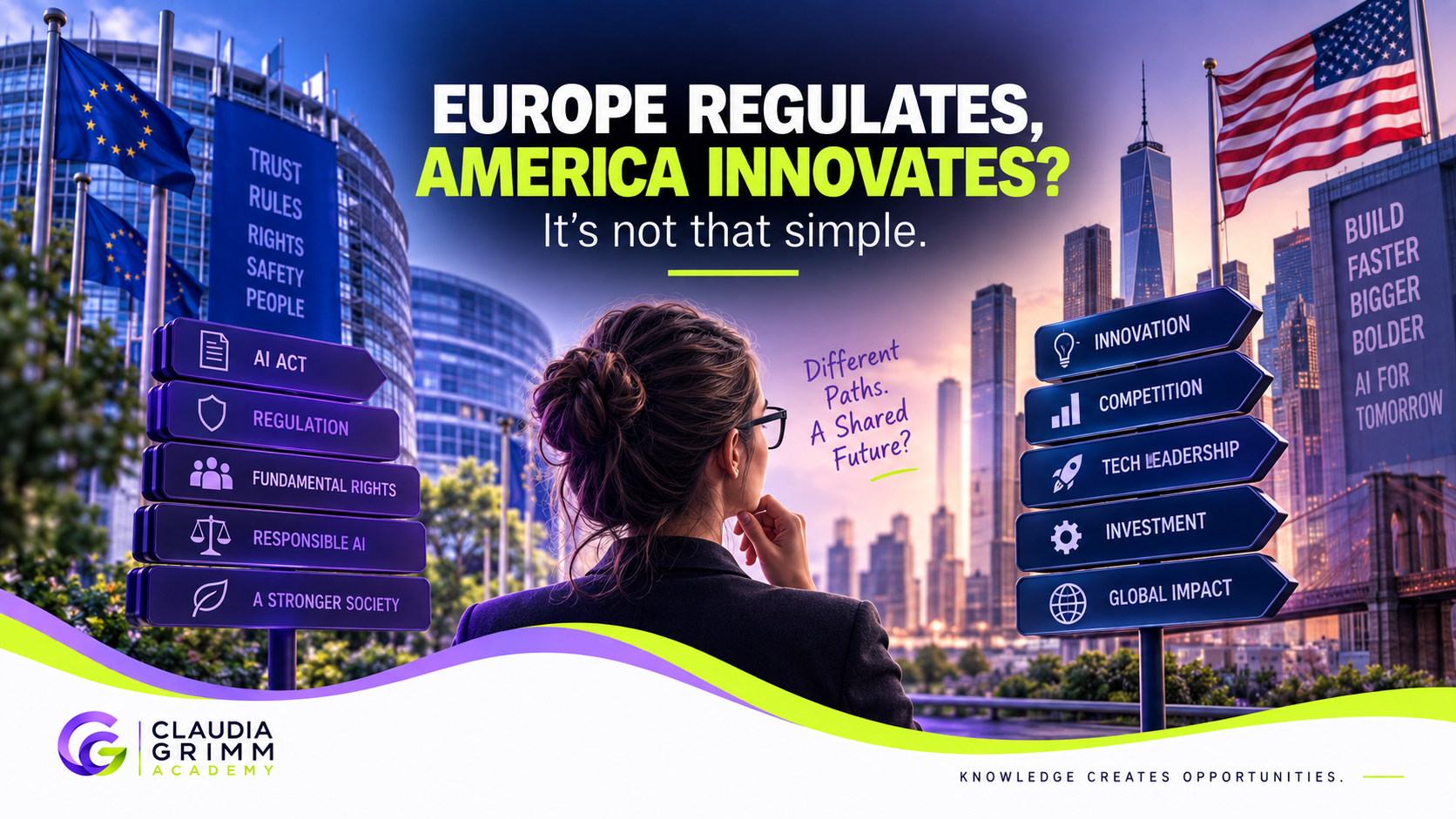
The EU AI Act represents a European approach to artificial intelligence built around binding rules. The United States currently places greater emphasis on innovation, competition and technological leadership.
That quickly creates a familiar picture:
- Europe regulates.
- America innovates.
We hear this contrast increasingly often when people talk about artificial intelligence.
On one side is the European Union with its AI Act, risk categories, transparency obligations and extensive requirements.
On the other are the United States — home to companies such as OpenAI, Google, Microsoft, Meta and Anthropic, all of which play a major role in the global AI landscape.
At first glance, the picture seems to fit:
- While Europe writes laws, America builds the technology.
But is that really true?
Not quite.
The United States is also deeply engaged in the question of how artificial intelligence should be governed.
The more interesting difference is not simply whether AI should be regulated.
The more interesting questions are:
- How much should governments prescribe? At what political level should they do so? And which risk matters more — too little oversight or too much regulation?
This is where Europe and the United States currently differ significantly.
Updated: August 31, 2026 · This article is intended for general information and educational purposes only and does not constitute legal advice.
WHAT HAPPENED?
Europe has created a horizontal legal framework with the AI Act, addressing different AI systems and applications according to their risks.
Since August 2, 2026, another major part of the Regulation has become applicable. The European AI Office and competent authorities in the Member States have taken on further enforcement responsibilities, while certain transparency obligations have also begun to apply.
Other provisions — particularly those concerning certain high-risk AI systems — will apply later. Under the current timeline, rules for high-risk use cases listed in Annex III will apply from December 2, 2027, while rules for certain AI systems embedded in regulated products will apply from August 2, 2028. Digitale Strategie Europas
The European approach is therefore relatively easy to identify:
- AI should be able to develop — but within a common legal framework.
The situation in the United States looks different.
In July 2025, the Trump administration presented America’s AI Action Plan, built around accelerating AI innovation, developing American AI infrastructure, and strengthening the country’s international position in AI.
The language itself reveals a difference.
European AI policy frequently emphasizes concepts such as trustworthy AI, risks, safety and fundamental rights.
Current US federal policy places strong emphasis on technological leadership, competitiveness, infrastructure and America’s position in the international AI race.
But that does not mean:
- Europe is against innovation.
- The United States is against regulation.
We need to look more closely.
WHY IS EUROPE TAKING THIS APPROACH?
The European approach is strongly influenced by the idea that certain applications of artificial intelligence can have significant consequences for people, safety and fundamental rights.
That is why the AI Act follows a risk-based model.
Certain AI practices are prohibited.
Certain high-risk applications are — or will be — subject to additional requirements.
Certain AI systems and AI-generated content are subject to transparency obligations.
General-purpose AI models have their own set of rules.
At the same time, many low-risk AI applications remain largely outside additional mandatory requirements under the AI Act.
This is an important distinction.
The European approach is not:
- “AI is dangerous. Therefore, we need to stop AI.”
It is closer to:
- “The greater the potential risk of an application, the more carefully we need to consider which safeguards are necessary.”
Behind this lies a political choice.
The state should not necessarily wait until problematic uses of AI have already caused significant harm before acting.
Some risks should be addressed in advance.
That has advantages.
It can provide companies with greater legal clarity.
It can establish common standards.
And it can offer protection in particularly sensitive areas.
But this approach also comes with a downside.
Rules create work.
Companies need to understand which role they have, which category a system falls into and which requirements follow from that classification.
And the more complex regulation becomes, the harder compliance may be — particularly for smaller companies.
This is where much of the criticism of the European approach begins.
WHY ARE THE UNITED STATES TAKING A DIFFERENT APPROACH?
Current US federal policy places the emphasis elsewhere.
The AI Action Plan explicitly aims to accelerate private-sector innovation and reduce regulatory barriers.
AI is also viewed as much more than just another technology.
It is treated as a strategic economic and geopolitical technology.
Countries capable of developing the most advanced AI systems may gain advantages in areas such as economic growth, science, defense, infrastructure and international influence.
Put simply, the underlying logic is:
- If AI is one of the key technologies of the 21st century, regulation should not cause the domestic technology industry to fall behind its international competitors.
That perspective also has understandable arguments behind it.
Technology develops extremely quickly.
Legislation usually does not.
A law has to be drafted.
Debated.
Adopted.
Implemented.
Interpreted.
And perhaps changed again.
By the time that process is complete, the technology may already have moved on.
SO DOES THE UNITED STATES HAVE ALMOST NO AI REGULATION?
No.
And this is where the common Europe-versus-America comparison becomes misleading.
The United States is not an AI regulatory vacuum. It has a different regulatory structure. Existing federal laws can apply to AI systems and AI-enabled conduct. Different federal agencies have responsibilities in their respective areas, while individual states have also developed their own AI legislation. This is structurally different from the European AI Act. The European Union has created a common horizontal framework specifically for AI. The American landscape is more fragmented. And that fragmentation has itself become a major political issue.
WASHINGTON VS. THE STATES?
This is where things become particularly interesting. Individual US states have been developing their own AI rules. From the perspective of the current federal administration, this risks creating a regulatory patchwork. In December 2025, President Trump issued an executive order calling for a minimally burdensome national AI policy framework and directing the creation of an AI Litigation Task Force to challenge certain state AI laws considered inconsistent with that federal policy. The White House
The administration argues that having different requirements across individual states can increase compliance costs and create particular difficulties for start-ups. The White House
And suddenly, the American debate begins to sound surprisingly familiar from a European perspective:
- Do we need common rules?
Except in the United States, that debate is taking place between Washington and the states. For a company, complying with different AI requirements in California, Colorado, Texas or New York can become complicated. Suddenly, the idea of a common regulatory framework does not sound quite so exclusively European.
The real disagreement becomes:
- What should that common framework look like — and how strict should it be?
TWO DIFFERENT KINDS OF RISK
Perhaps the difference between the two approaches becomes clearest when we look at the risks each political system currently emphasizes.
European AI policy focuses strongly on risks involving areas such as:
- fundamental rights, discrimination, manipulation, transparency, safety and the potential impact of particularly powerful AI systems.
Current US federal policy also addresses risks, but places particularly strong emphasis on other concerns:
- losing technological leadership, slowing innovation, insufficient computing infrastructure, dependence on foreign technology and regulatory burdens on American companies.
Both sides therefore talk about risk.
But they do not always mean the same risk.
Europe more often asks:
- What could happen if we do not control this technology sufficiently?
Current US federal policy more often asks:
- What could happen if we constrain this technology too much?
And once we understand that difference, their different policy responses become much easier to understand.
BUT DOESN’T EUROPE ACTUALLY SLOW DOWN INNOVATION?
It is a legitimate question.
Regulation is not free.
When companies have to meet extensive documentation, testing and compliance requirements, that costs money, staff and time.
For a multinational technology corporation, that may be inconvenient.
For a start-up with twelve employees, it can be a much bigger issue.
The European Union has increasingly acknowledged this challenge.
In 2026, the EU agreed on simplifications to the AI framework intended to make implementation easier and more innovation-friendly while maintaining protections relating to safety and fundamental rights.
The changes also adjusted the timetable for high-risk AI requirements. Digitale Strategie Europas
That is significant.
Because it demonstrates that Europe is not simply trying to create as many rules as possible.
The EU itself has to find a balance between:
- Protection and innovation.
And that balance can change.
ARE FEWER RULES AUTOMATICALLY BETTER FOR INNOVATION?
That would be too simple as well.
Companies do not only need freedom.
Sometimes they also need legal certainty.
If nobody knows what requirements will apply two years from now, investment decisions can become more difficult too.
A common regulatory framework can therefore have advantages.
Companies can know which basic rules apply.
Customers may develop greater trust.
Common standards can emerge. And a company that develops a compliant system may be able to offer it throughout a large common market.
The question is therefore not:
- Regulation = bad for innovation?
It is:
- When does regulation create trust and legal certainty — and when does regulation itself become an obstacle?
There is no mathematically perfect answer.
WHICH APPROACH IS BETTER?
There is no simple factual answer to that question because the two approaches prioritize different policy goals and risks.
The current American approach places greater emphasis on accelerating technological development, experimentation, investment and global competitiveness.
That may reduce some barriers to innovation, while potentially leaving some social or regulatory questions to be addressed later.
The European approach seeks to address certain risks earlier through a common legal framework.
That can create safeguards and legal certainty, but complex or difficult-to-implement rules can also increase costs and slow development. And importantly, neither system is standing still.
The United States is debating the relationship between state rules and common federal standards.
Europe has already simplified parts of its implementation framework and adjusted timelines in an effort to make the AI Act more workable and innovation-friendly. The White House
So the story is far from finished.
AND WHERE DOES CHINA FIT IN?
When we talk about the international AI landscape, one major actor is obviously missing:
- China.
But squeezing China into a third column in an article comparing Europe and the United States would not do the subject justice.
Technological development, industrial policy, regulation and state control interact there within a different political and legal structure.
That deserves its own article.
For this comparison, one point is particularly important:
The international AI competition is no longer only about who builds the best model.
It is also about whose:
standards,
technologies,
infrastructure
and ideas about AI governance
gain international influence.
AI governance has therefore also become a geopolitical issue.
WHAT DOES ALL OF THIS MEAN FOR US?
For someone who simply uses a chatbot, a debate between Brussels and Washington can seem very far away.
But these political decisions can influence:
- which AI products are developed, which products reach Europe, what requirements companies have to meet, how certain AI-generated content is labelled, what rights users have and which technological standards may eventually spread internationally.
So when we talk about AI regulation, we are not simply talking about legal paragraphs.
We are talking about a much bigger question:
- How do societies want to deal with a technology that can change economies, work, information and power?
Europe currently gives one answer.
The United States gives another.
At least for now.
MAYBE WE NEED BOTH
Discussions about Europe and the United States are often treated like a football match.
Who wins?
Who loses?
Who has the better strategy?
But perhaps that framing is too simplistic.
We need innovation.
Without people and companies willing to experiment and build new things, technological progress does not happen.
But societies also create rules.
Technological progress alone does not answer the question of which applications we are willing to accept or under what conditions they should be used.
The difficult task is making both possible at the same time.
Regulation that makes useful innovation unnecessarily difficult creates problems.
But innovation policy that ignores meaningful societal consequences can create problems too.
Perhaps the more useful question is therefore not:
- Europe or the United States?
But:
- What can both approaches learn from each other?
Europe can continue asking how regulation can become simpler, faster and more innovation-friendly.
The United States can continue debating where common and reliable safeguards are necessary.
And both have to accept that no regulatory framework will ever be permanently finished.
Because while we are still debating how to govern today’s AI, tomorrow’s AI is already being developed.
Perhaps the real challenge is not choosing between innovation and regulation.
It is creating rules capable of coexisting with innovation — and enabling innovation that does not treat responsibility as an obstacle.
This article is intended for general information and educational purposes only and does not constitute legal advice.
Sources & Further Reading
Europäische Kommission – AI Act / Regulatory Framework for AI
Europäische Kommission – Durchsetzungsrahmen des AI Act
Europäische Kommission – AI Omnibus
The White House – America’s AI Action Plan
The White House – AI Action Plan, Überblick
The White House – Export of the American AI Technology Stack
The White House – National Policy Framework for Artificial Intelligence
Congressional Research Service – Regulating AI: U.S. and International Approaches